
We have a love/hate relationship with executive summaries. On the surface, they’re a great idea. What’s not to love? You’ve invested countless hours crafting a compelling narrative with data, insights, and strategic recommendations. Now comes the moment of truth: distilling that entire story into a single, powerful overview that immediately captures your audience’s attention. Your time-pressed executives – juggling back-to-back meetings – should instantly understand your core message and feel compelled to act.
In theory, it’s brilliant. In practice? It’s where many presentations fall apart before they even begin.
Poor executive summaries can sabotage business results and organizational success
Here’s the hate part: Even the most well-crafted stories, distilled down into one page, can easily turn into a crowded, impossible-to-digest data dump. Those who’ve spent a lot of time organizing their ideas, data, and recommendations into the arc of a story are forced to make decisions about what to keep and what to leave out. What’s often presented is a bullet-filled executive summary – with tiny font to save space – that’s neither emotionally, visually, or even logically compelling. On slide #1, right out of the gate, you’re in danger of losing your audience.
 To make matters even more difficult, executives are short on time and expect to begin meetings with a clear overview of the main topic and its key components. Maximizing everyone’s time requires having a two-way dialogue rather than explaining busy charts and text-heavy slides. When audiences can’t grasp your key message, meetings devolve into clarifying questions and tangential discussions, causing objectives to miss their mark and decisions to stall. Ultimately this leads to yet another meeting and a loss of productivity for everyone involved.
 On the flip side, the ability to net out your message and share insights needed to make informed decisions will have a huge impact on organizational outcomes. You demonstrate clear value to the business while elevating your team’s reputation and visibility. Critical initiatives move forward, and most importantly, trust and credibility with stakeholders grow – all driving the company’s strategic goals forward.
This is where a well-crafted executive summary can make all the difference.
Aim your executive summary squarely at your audience
Many companies have clearly defined rules about what executive summaries should look like, but the most important factor to consider is your audience. The expectation of your cust omer, boss, or strategic partner should weigh heavily in how you craft your executive summary. For example, flashing it for 90 seconds as the first slide of your presentation might make sense for one audience, but a left-behind one-pager might be more valuable for another. Some companies give you carte blanche to design it however you wish while others require the title “Executive Summary” on top with specified sections below. Regardless of the form or layout, it is crucial to always tailor your executive summary to your unique audience.
 Yes, you can absolutely tell a story on one page
Brain science tells us that organizing your ideas and data in a story structure will help your audience quickly remember your ideas. And an executive summary is the perfect opportunity to tell a story on one page. The arc of a great story includes setting, characters, and conflict (the WHY of your story); a BIG Idea (the WHAT of your story) and resolution (the HOW of your story). Can you build a quick and efficient executive summary that fits all these elements into one page and does not become a jam-packed mess? Yes. Let’s see how…
Example 1 – GO Insurance
Here’s a typical one-slide executive summary of a company called GO Insurance that is concerned with how to reach the next generation of insurance shoppers. In the “before” version below, you will see there are only some elements of a story present (but plenty of bullets and text!).
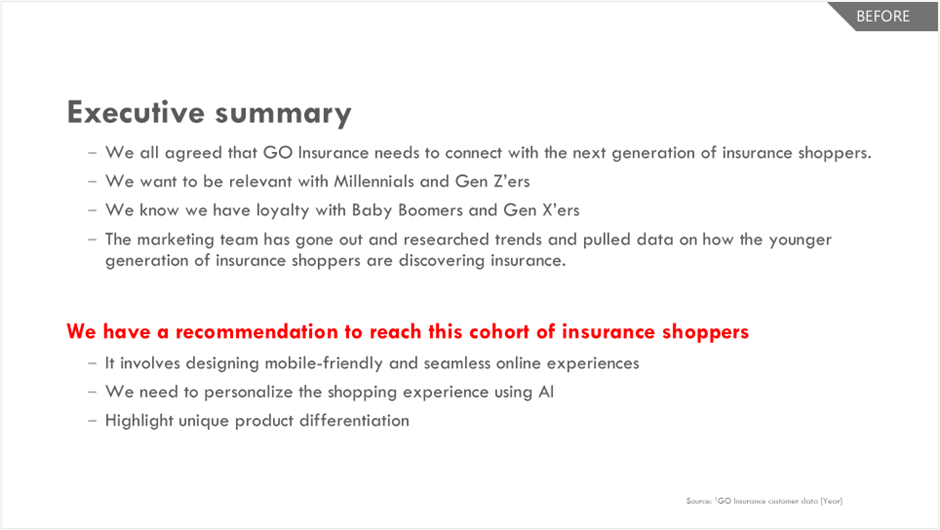
Besides the passive heading at the top that doesn’t capture the BIG Idea, notice in the top portion of the slide, there are statements that represent the WHY of the story (setting, characters, and conflict). The setting (insurance market) and characters (Millennials/Gen Z/Boomers/Gen X) can also be identified. But the problem here (besides the boring look), is that there is nothing in the way of conflict. The audience is left wondering: why should I care?
What’s not working? Here’s a marked-up version of the GO Insurance “before” executive summary slide:
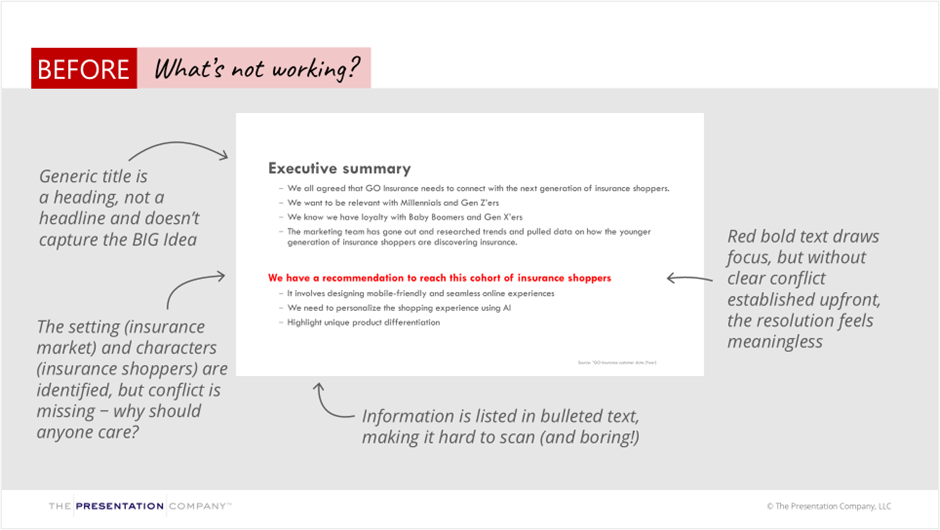
The bottom portion is all about the HOW (or story’s resolution) in the form of recommendations. This is problematic because without defining the conflict, the resolution feels meaningless.
Ready for some relief?
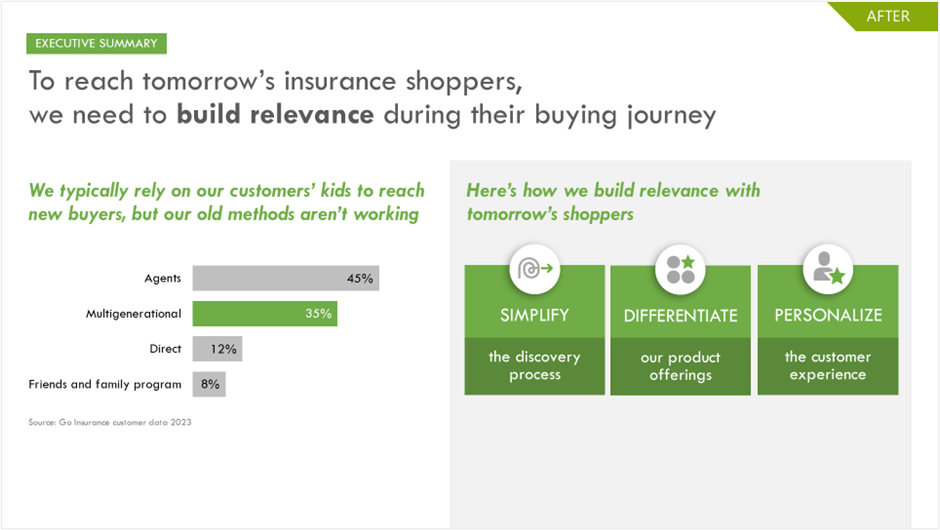
The “after” slide below shows the same executive summary, now with all four signposts and a BIG Idea. Notice how the BIG Idea (the WHAT of the story) is built right in the slide headline: To reach tomorrow’s insurance shoppers, we need to build relevance during their buying journey. Another great trick on this slide is the smaller header above the larger headline reading: Executive Summary. This works well when companies require stricter templates with an executive summary slide that must read “executive summary.” The slide doesn’t waste important storytelling real estate on a boring, generic heading that doesn’t move the story along.
What’s working? Here’s a marked-up version of the GO Insurance “after” executive summary slide:
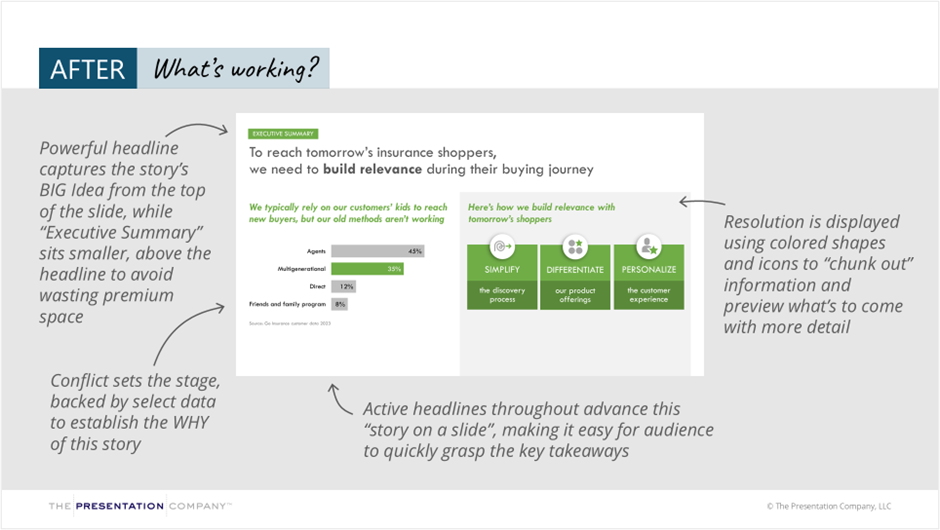
 If you take a look at this “after” executive summary through the lens of storytelling, you’ll notice the WHY is on the left and is heavily focused on the conflict. On an executive summary slide, the conflict should be front and center and ideally, backed by key data points. Worth noting that characters and setting are secondary. If they can be woven in lightly, great, that can increase the emotional connection of your story. In this example, there is mention of “customers’ kids” and “new buyers” as a hint of characters, but again, the conflict is central.
Notice the HOW of the GO insurance story (a.k.a. the resolution) on the bottom right does not go deep into recommendations. This is more of a high-level preview. The recommendations are teased but true details will be revealed when the full story is told in supporting drill-down slides.
What’s the bottom line? This executive summary offers a quick and easy way to grasp the essential elements of the story – the WHY, WHAT and HOW – all on one page.
Example 2 – Quantum Airlines
In our next example, Quantum Airlines is proposing ways to combat a pilot shortage. We’ll let the “before” executive summary speak for itself:
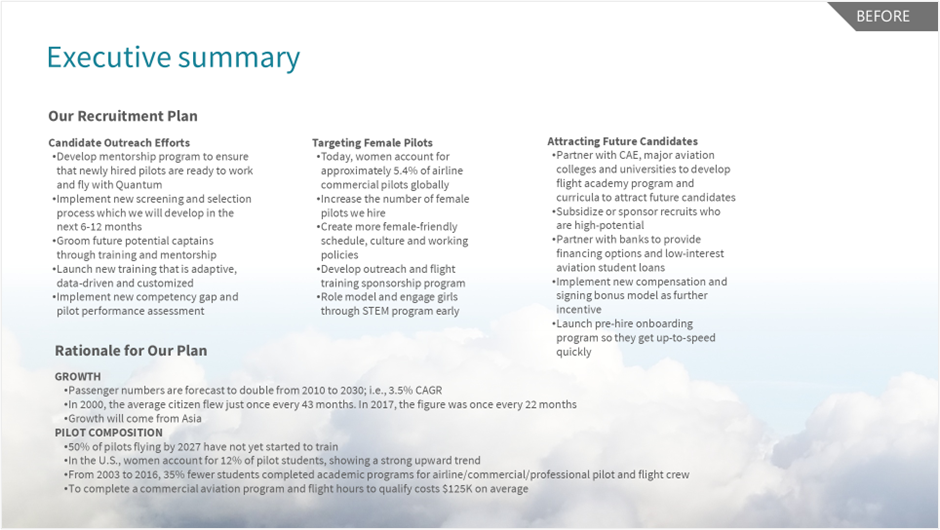
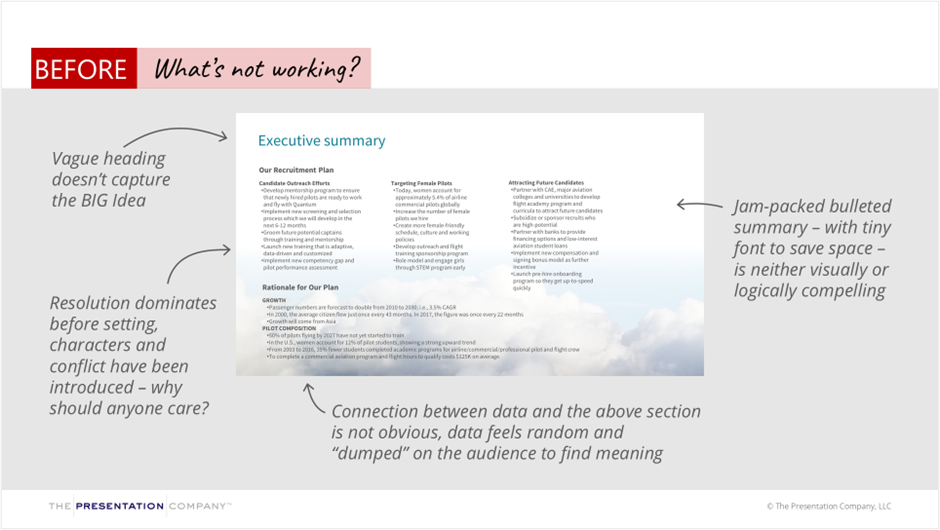
Obviously, this is an eyesore with bullets galore! As pointed out below, the headline doesn’t say much and is really just a header. The slide jumps to all kinds of resolution before setting, characters, and most crucially, conflict has been established. And finally, the data is not being used strategically to support the story.
What’s not working? Here’s a marked-up version of the Quantum Airlines “before” executive summary slide:
You know the drill by now…ready for some relief? Let’s move on to an executive summary that tells a story.
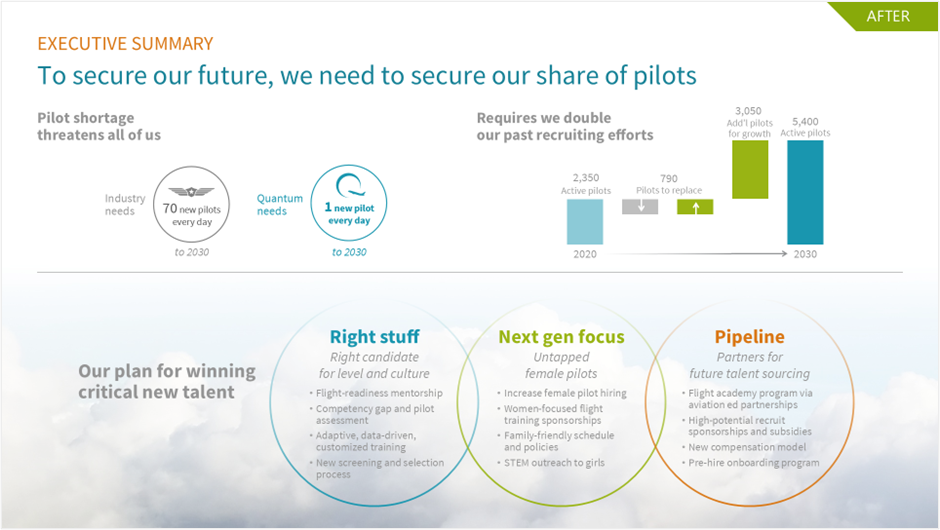
Here’s a great use of a BIG Idea headline: To secure our future, we need our share of pilots is again, a blaring headline at the top. The WHY is focused on the central conflict of the story: Pilot shortage threatens all of us. And finally, the resolution is at the bottom, directly addressing the conflict.
What’s working? Here’s a marked-up version of the Quantum Airlines “after” executive summary slide:
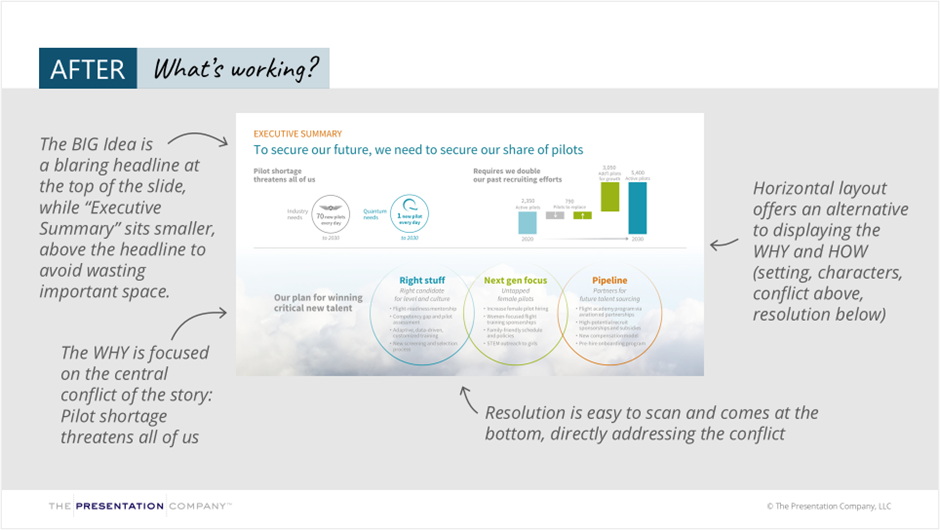
 Worth pointing out: The horizontal layout of this executive summary is slightly different than the other example as it reads more top to bottom. But, the layout isn’t as critical as ensuring that your BIG Idea (your WHAT) is your dominant headline and that you’ve articulated your WHY and HOW.
To Recap: Storytelling + Executive Summaries = ❤️
By applying effective story strategy, any residual hate feelings for executive summaries should tip in favor of love. Introduce just the key elements of your story, revealing glimpses of the WHY, WHAT, and HOW. Done right, this will pique the curiosity of your audience, compel them to lean in, and offer you the spotlight for your full story.