
We get it— you’ve finally landed a meeting with a key stakeholder and a lot is at stake. But you’re swamped with work, deadlines are looming, and time is slipping away. You’re desperate to craft a stand-out presentation to make an impact, and quick. What could give you the jumpstart you need to get it done?
Enter AI.
Across industries and business functions, the use of AI is progressing at breakneck speed. In a recent survey by McKinsey, 65% percent of respondents said they were regularly using generative AI in at least one business function, up one-third from just a year ago.1
The growth isn’t all that surprising; after all, the benefits of AI are valid. A report from Forbes revealed that 97% of business owners believe ChatGPT will help their business.2
But there’s another side of AI to consider. While AI is a powerful tool for organizing information and increasing efficiency, it lacks two key elements of effective communication—emotional intelligence and creative thinking.
As one expert said3, “Machines will never be able to disentangle the intricacies of diverse human motives and biases that color all our interactions with information.”
The truth is, decision-makers need more than an AI output to be engaged; they need inspiring content that feels personal and speaks directly to their needs.
They need storytelling that keeps humans at the center of the narrative.
Stories are a great way to bridge the gap between AI complexities and human imagination. By pairing the art of business storytelling with the science of AI, you can tap into the future of effective communication. This potent combination gives you the best of both worlds—improved efficiency and memorable messaging.
How AI can complement business storytelling
Let’s go back to that presentation you need. Think of AI as an extra resource to help you get started – like having an intern to conduct research on your behalf. Just as you would with an intern, you’d want to check and validate what AI produces. While there’s value in leveraging AI for brainstorming and ideation, you’d be remiss not to review and approve the outputs before using them.
So while it’s a great workhorse, AI takes the human element out of communication. And when it comes to building lasting business relationships and trust, the human element is what makes all the difference. AI should be thought of as a collaborative partner – not a replacement for human expertise.
But this is where storytelling and AI emerge as the new power couple… the real magic happens when you combine the two.
Still not convinced? Here are six ways AI can help create engaging business communications in tandem with storytelling techniques:
1. Audience analysis and personalization: AI can analyze audience data (like demographics, preferences, and engagement history) to tailor your story. This allows storytellers to personalize content, tone, and examples to resonate with specific audiences, making your narrative more relatable and authentic.
2. Content generation and organization: AI can generate and organize content based on industry-specific trends and topics. It can suggest anecdotes, examples, and key points that align with your message, creating a coherent and engaging flow that guides the audience through your story.
3. Data analysis and curation: AI can analyze big data to identify trends, patterns, and insights, which can serve as the foundation of compelling data stories. Storytellers can use these insights to create narratives that resonate with their audience, provide actionable recommendations, and enhance decision-making.
4. Visual enhancements and media suggestions: AI tools can recommend visuals, such as photos, charts, and icons, that reinforce and enhance key messages. These elements not only make a presentation visually appealing but also help illustrate your ideas and data, making complex information easier to understand.
5. Dynamic storyboarding and script writing: AI can help outline the narrative arc of a business story by suggesting storyboarding techniques that guide the presenter in building a clear, persuasive narrative. It can even draft scripts and suggest transitions that keep the storytelling smooth and engaging.
6. Flex based on audience sentiment and feedback: AI can provide feedback on the effectiveness of your customer-facing business communication by analyzing audience reactions (e.g., social media, reviews, other digital content). This helps organizations understand how their brand is perceived, and enables presenters to adapt their messaging to better connect with the audience and address customer opinions and concerns.
Storytelling’s differentiator: a common language for everyone
Despite its growth, levels of AI adoption can vary across any given organization. Not everyone has the same level of access, uses it consistently (or at all!), or operates from the same tool. And since AI outputs can widely differ based on how a question is asked, the results can be inconsistent. To navigate this issue and ensure everyone is operating from the same communications playbook, we need to align everyone around a common language and framework. The common language of storytelling becomes the missing ingredient to bring clarity, meaning, and humanity to AI’s contributions.
Personalizing AI with storytelling
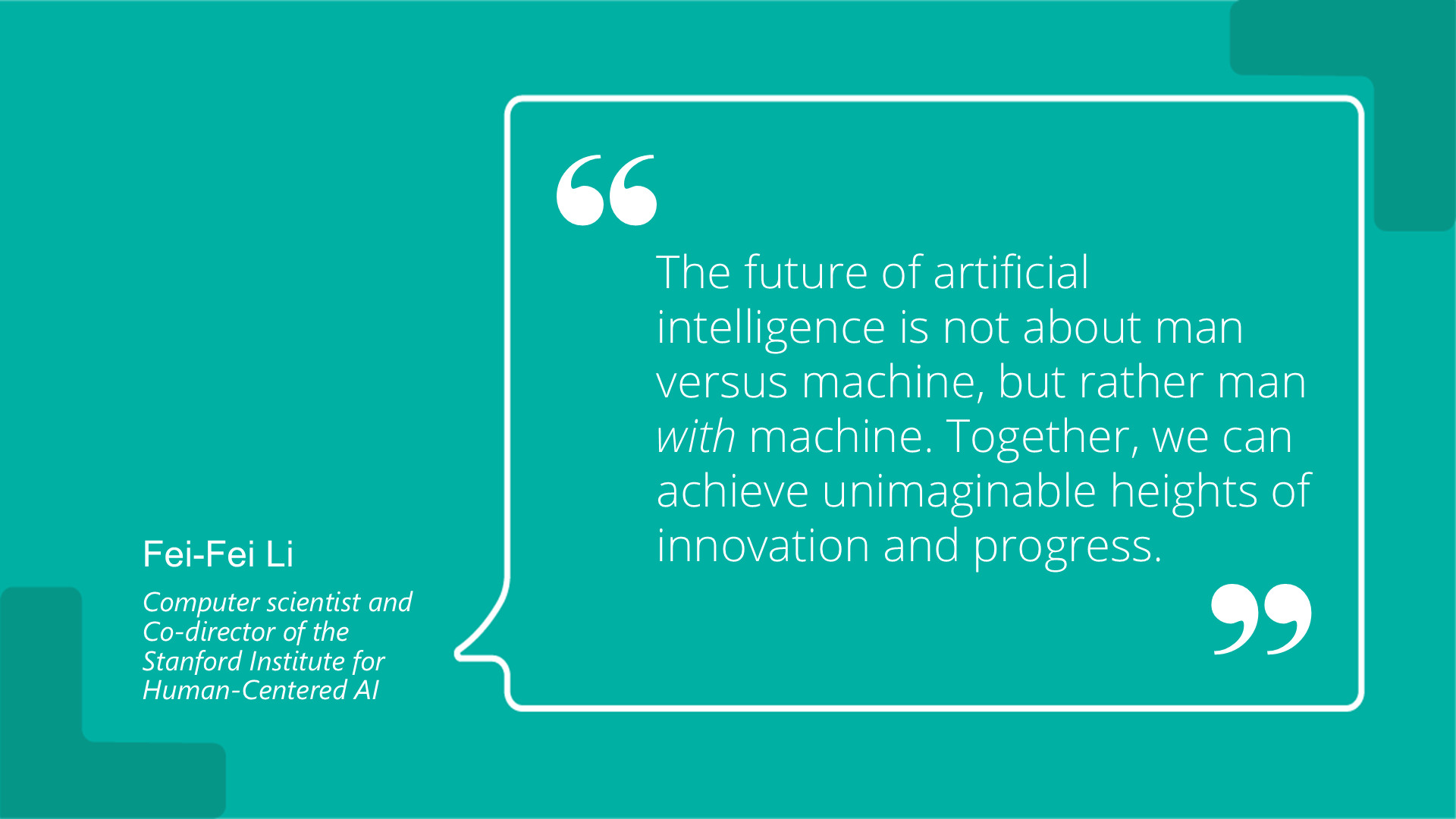
There’s no doubt that AI has changed business as we know it. We should all lean in and embrace how it might benefit us. The key is to strike the right balance between human and AI collaboration, where the human remains in the driver’s seat and uses AI as a supportive tool, not an autonomous replacement.
We believe storytelling with AI assistance requires thoughtful human intervention and oversight to produce an output that keeps humans at the center of every story. By harnessing the power of AI in tandem with storytelling, you can create effective business narratives – quickly and efficiently – that make complex data relatable, evoke empathy, and, most importantly, turn decision-makers into business partners.
References
1 McKinsey, The state of AI in early 2024: Gen AI adoption spikes and starts to generate value
2 Forbes, How Businesses Are Using Artificial Intelligence In 2024
3 Hopkins Bloomberg Public Health magazine, Why AI Needs People
4 Peak AI blog, 16 inspiring quotes about AI